All this talk about Hurricanes reminds me of Hurricane Carol which hit where we lived when I was a kid. At the time we lived in Pawcatuck, Connecticut, right on the line with Westerly, Rhode …
Though folklorists claim there is no written evidence for the superstition before the nineteenth century, the date has long been connected to notorious events in history and religion. According to Roman Catholic belief, one …
The #911Tartan by designer Stacy Clark. This somber #tartan was designed to remember the fateful events of September 11, 2001. 9/11″ is literally weaved within the very fabric of the material. In 16oz wool …
I originally wrote this on 9/11/01… I, too, was stunned to hear the news this morning and continuing throughout the day. It was just something unbelievable. My husband and I were on a Land …
If you know me, you know that I nearly always have a cup of coffee nearby, at all times. I’m glad that coffee has its own day now 🙂
The date might not be marked on your calendar, but if you are like more than 50 percent of adults who drink coffee every day, maybe it should be. Today is National Coffee Day, which means you can find free or reduced priced coffee in many places.
All this talk about Hurricanes reminds me of Hurricane Carol which hit where we lived when I was a kid.
At the time we lived in Pawcatuck, Connecticut, right on the line with Westerly, Rhode Island. Luckily, we also lived on a small hill.
My Mom said “let’s go down and see the waves” so we drove to Misquamicut Beach, about 15 minutes away.
Our car got stuck in the rising tides and we probably would have washed out to sea had we not been blocking the path of a truck who wanted to get out of the area fast. That truck pushed us to safety.
We lived on a small embankment and when we got home, we could see that the road directly below us was flooded and people were going by in rowboats.
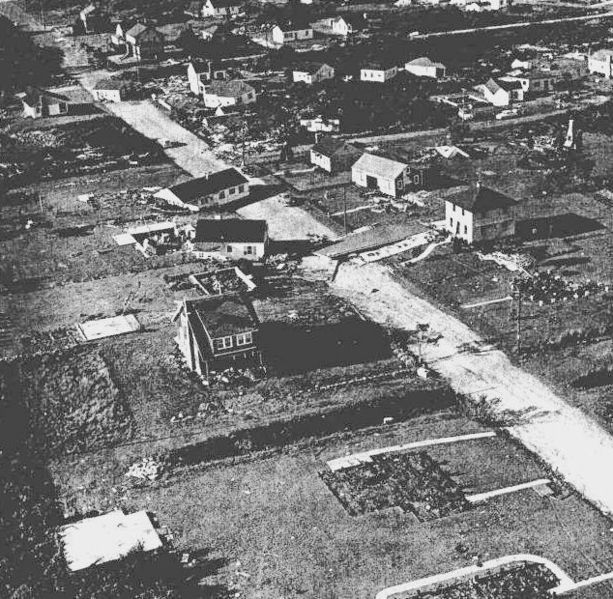
Carol, the first named Hurricane to impact the northeast arrived Tuesday, August 31, 1954. 10 days later another hurricane struck on September 11th. Edna caused more localized damage including the Cape Cod area. This promotional feature is from the photo album Hurricane! – published in 1954 by The Standard-Times.
WESTERLY — Carol Nash and Joe Potter were cheerfully preparing for their wedding during the summer of 1954 when they were hit with a double whammy.
Days before the wedding, on the morning of Aug. 31, Hurricane Carol, the most destructive hurricane to strike Southern New England since the Great New England Hurricane of 1938, came crashing ashore in coastal Rhode Island and Connecticut, causing significant flooding, knocking out power for weeks in some areas, and leaving 65 people dead. The hurricane would forever change the face of Misquamicut.
On the Potters’ wedding day, 10 days later, Hurricane Edna, which followed a track slightly east of Carol’s, barreled into southern New England with hurricane-force winds of 75 to 95 mph, buffeting all of eastern Massachusetts and coastal Rhode Island and claiming 21 lives.
Their stormy beginnings may have brought the Potters good fortune. On Sept. 11 they will celebrate 60 years of marriage. The parents of two daughters, and grandparents of two grandsons and a granddaughter, the Potters have traveled widely and now divide their time between Weekapaug and southern Arizona. Earlier this month they sat on their back deck overlooking the Weekapaug Breachway, recalling the two hurricanes of 1954.
Hurricane Carol destroyed much of Atlantic Avenue, they said, noting that the section now called Misquamicut State Beach was once dotted with summer homes. Joe Potter, who was living with his sister in Ashaway, was working for a man who owned the old Sunoco Station on Granite Street.
“He had some houses and a boat in Matunuck,” Potter recalled, and one of his houses was washed into a field.
Carol, who worked in data processing at the Pawcatuck-based Cottrell’s Printing Company in 1954, remembers how she had to travel to New Haven by train for work since there was no power on Mechanic Street where the company was located, and all the machines were shut down.
The traveling time cut into her last-minute wedding tasks, so she had to enlist her mom, Lillabeth Nash, who took the bus to Providence to pick up one very important item.
“I bought my wedding dress at Shepard’s Department Store,” recalled Carol as she described the rigors of travel to Providence in the pre- I-95 days. “And thank goodness they kept the dress upstairs because the entire basement of Shepard’s was flooded.”
The Shepard Company Department Store was once the largest department store in New England. Hurricane Carol was not kind to Providence, its surge submerging much of the downtown in 12 feet of water.
But Carol Nash’s wedding dress survived, and her mother was able to retrieve it and lug it back to Westerly on Sept. 11, the same day that Edna came roaring into town.
There was a good supply of raincoats and umbrellas on hand that morning for the bridal party and guests, and when Carol and Joe made it halfway down the aisle of Our Lady of Victory Church in Ashaway, the power went out.
The Potters were not only married by candlelight, but their wedding reception was also a candlelight affair.
****
Susan Sullivan Brocato, a longtime library assistant and guidance office secretary for the Westerly School Department, was a child when Hurricane Carol hit the coast. She remembers the day before the hurricane, driving to Watch Hill where her family had a cabana at the Watch Hill Yacht Club, taking her WoodPussy sailboat, Skip-It, out of the water and cleaning out the cabana.
“There seemed to be a lot of concern about the storm,” she said. “It was scary, but there was also excitement.”
Brocato said that back in 1954, the cabanas were sitting right on the sand, level with the beach.
“We waited out the storm at our home in Bradford only to find, when we returned the following day, that the cabanas were destroyed,” Brocato recalled. The Sullivans spent the next summer at Seaside Beach Club while the Watch Hill cabanas were rebuilt.
When they were completed, the cabanas were raised on stilts.
****
Although Stonington native Joe Rendeiro wasn’t in the states when Hurricane Carol slammed coastal New England, he remembers well the stories his father told about the storm and the damage it caused. Rendeiro, like his father before him, is a retired commercial fisherman. On Aug. 31, 1954, he was in the Mediterranean serving in the U.S. Navy aboard the USS Salem. As a member of the shore patrol, his job was to keep an eye on the sailors. He remembers walking into a shore-front hotel on Sept. 1, 1954, and noticing a woman reading The New York Times. When he glanced at the paper, the headline caught his attention.
“The headline said ‘Hurricane Carol hits New England,’” recounted Rendeiro. “For two days I tried to call home and finally I got through.”
When he reached his home in Stonington, his mother, Rosa Rendeiro, gave him another kind of headline: Stonington had been hit hard. There had been an incoming tide, and boats had been lifted up and thrown upon the grassy area of town owned by Tony Longo.
“They told me that boats were spread all over town and that there were sailboats up against the railroad tracks,” Rendeiro said. “It caused a lot of damage to the fishing fleet.”
Rendeiro said his father’s boat, America, pretty much survived, but needed a lift from Chet Perkins, the owner of the local crane operation. His dad’s car did not fare as well.
“My father had a 1952 Pontiac from Joe Brustolon’s,” Rendeiro recalled. “He and Joe played poker together so he got all his cars from Joe.”
Rendeiro said his father thought he had parked the Pontiac far enough away from the rising tides, but he was mistaken.
“It was totally destroyed,” Rendeiro recalled. “When I came home that November he had a brand new Pontiac.”
****
Misquamicut resident Don Gentile, a self-described weather junkie and author of several local history books, including the Arcadia Publishing Company’s “Misquamicut,” was a young boy in late August 1954.
“I remember riding down Atlantic Avenue after the hurricane and seeing all the cottages that ended up in the pond, cottages that had been lifted off their foundations,” said Gentile. “They were there for a long time, too.”
When the Great Hurricane of 1938 destroyed most of Westerly’s waterfront, demolishing structures from Weekapaug to Napatree Point, people were reluctant to rebuild, Gentile wrote in “Misquamicut.” But by the early 1950s, people were less apprehensive, he said, and cottages and smaller buildings like hot dog and ice cream stands began to reappear by the beach. Lenny Malagrino, a local entrepreneur, brought in so-called “Groton Cottages,” small houses that had been used to house military personnel during World War II, and sold them for $500 apiece. People could buy a house and a lot for as little as $1,000, Gentile said.
By 1954, more than 50 cottages dotted the beach in Misquamicut, Gentile said.
“Little did people realize as the rebuilding continued,” he wrote, “a tropical entity in the South Atlantic would again have a say in Misquamicut’s future. Hurricane Carol would soon be visiting Misquamicut and it would not be pretty.”
One of the property owners, the late Henry Morris, Gentile reported, owned a cottage on lower Crandall Avenue (“Hurricane Alley”) that was moved off its foundation and up the street by the hurricanes of 1938, 1944 and 1954.
In total, more than 4,000 homes, 3,500 cars and 3,000 boats were destroyed and 65 lives were lost as a result of Hurricane Carol, according to the University of Rhode Island’s Graduate School of Oceanography. With damages totaling over $460 million, Carol was the costliest natural disaster in U.S. history until Hurricane Diane surpassed it the following year.
In 1955, Rhode Island Gov. Dennis Roberts introduced legislation to condemn the one-mile stretch of beach and secure it for the state by right of eminent domain. The legislation passed, and in 1959, Misquamicut State Beach was opened to the public.
****
Patty McKinney, whose family has owned property in Weekapaug for generations, was a little girl at the time of Hurricane Carol but vividly remembers the hubbub surrounding the event. On the day after the hurricane, Patty was in the family car with her mother, aunt and sisters, driving down Weekapaug Road to check on the cottage, when suddenly her mother let out such a sound that Patty was startled and scared until she saw what her mother’s exclamation was all about.
“There was a house in the middle of Weekapaug Road,” McKinney recalled. “We later heard that the house had floated across the pond and landed there, right in the middle of Weekapaug Road.”
McKinney said she also heard that the house was moved to Chapman Road, where it sits to this day.
“It’s the second house on the right,” she said. “It’s still there.”
nbfusaro@thewesterlysun.com
I am so thankful for that truck driver that needed to get away from the storm!
The ship is really rolling tonight – I’m having trouble sleeping due to the closet doors opening and shutting themselves. The chairs on the balcony have rearranged themselves to be right up next to the door.
From Cruise Critic:
Jose is projected to be directly between NYC and Bermuda on Sunday when we are scheduled to sail.
As of the latest run of the GFS Jose would be due west of Bermuda half way to SC coast on Sunday the 17th. [I will attach the map of this.] After that Jose is projected to slide north then recurve out to sea heading NE. Late on Wed. the 19th Jose is forecast to be 350-400 miles SE of Nantucket.
IMNHO, the Breakaway will sail to Bermuda heading a bit more out to the east than its normal straight line course. Going to the North or to the South would take the Breakaway into Jose direct influences. There may be a bit of a swell, but by going [fast] to Bermuda will avoid most of the winds of the storm.
All this said we are talking about events 6+days out. A lot can change in that time
~~~
I had trouble flushing the toilet about 4 am – at 6:59 it flushed itself!
Wave height 14.5. normal is 8
~~~
After lunch people out on deck were huddled under towels in rain.
I shared this on Cruise Critic:
They’re reporting that the waves are 14.8 and have been most of the day. The TV calls them “rough mounting” but I’m not sure what that is.
The upper decks are closed but there are hopeful folks in deck chairs wrapped in towels – and it’s raining.
We used my backpack to stop the doors from crashing so much.
Internet is working fine – it’s all good for me as long as I can get online. LOL
Our path keeps changing and we’re going further north and west, then heading back to Bermuda. I’ve been taking screenshots of the TV and I’ll post them in a bit.
Here’s an image I edited this morning as an overview for the folks back home.
6:21 Waves 21.3
Sea state Rough
September 19, 2017
The wind is blowing quite loudly
We’re heading home on Thursday at 5:00 PM instead of Friday due to the hurricane 😦
Posted on Facebook
Update, for those interested… We’ve had to go further and further around the storm (Jose) and the waves have been buffeting us around a bit.
We’re doing ok and I have lots of books on my Kindle so I’m good for a long time. The people who wanted to lie out by the pool are out of luck. The pools are closed and drained, often the decks are closed so everyone is eating and shopping – and in the casino, I guess.
The captain just announced that we’re going to have to cut our time in Bermuda short by a day because we’re going to have to skirt a hurricane (the same one?) on the way back.
I had a snorkel trip planned for that day so I’m a bit unhappy about that but it’s better to be safe…
Posted on Cruise Critic
We’re still trucking along, due to be in Bermuda tomorrow morning at 5:30 am as planned.
The pools have never been opened, as far as I know, and the decks are usually closed due to high winds.
Earlier today, the captain said we might have sun by Thursday.
Tonight he announced that we would be leaving Bermuda early, on Thursday afternoon at 5 instead of Friday at 4 to continue sailing around whatever hurricane is out there now.
I was able to reschedule the shore excursion I had lined up with an outside tour company, so that’s good. We did an excursion, but not through NCL, although the same one was offered through them. We were supposed to go out on Friday, on the Rising Son but, when we learned that our ship was leaving port on Thursday afternoon, I contacted them to cancel. They offered us a Thursday morning snorkel trip, which I accepted. Had we been on the same excursion as offered by NCL, it would have cost us more money at the outset but it would have been automatically canceled, so we would have missed out.
~~~
Response to above post on CC:
Wow, thanks for the live update – been looking at ship webcam off-and-on, looked like ship is still sailing in large swells w. bits of small whites, guessing it’s 10′ to 12′ seas & windy. we ran into that for a day last year coming back from Dockyard … a bumper.
Must be one packed atrium lobby with all the displaced outdoor chair hogs unable to sunbath …
Hurricane Maria doing major damages down in the Caribbean, expected to hit Puerto Rico directly & hard starting tonight, then continue its path as a Cat-5, possibly missing some of the Bahamas islands … and maybe weakened somewhat – turning north/northeast in the direction of Bermuda. This latest forecast model is probably what prompted NCL is modify your time on the islands, sorry – it’s mother nature – 2 full “fun” day at sea to sail around & outrun Maria next.
From BDA’s local forecast office: Bermuda will maintain showery and thundery conditions into Wednesday. Moderate to strong winds gradually ease light to moderate by Wednesday evening. Thursday is a mix of sun & clouds, high of 82 degree. (Seas outside the reef for arrival, 6 to 10 ft.)
Sadly, the Windjammers have gone out of business. In October 1998, Hurricane Mitch was responsible for the loss of the s/v Fantome, a four-masted schooner operated by Windjammer. All 31 crew members aboard perished; passengers and other crew members had earlier been offloaded in Belize.
The ship, which was sailing in the center of the hurricane, experienced up to 50-foot (15 m) waves and over 100 mph (160 km/h) winds, causing the Fantome to founder off the coast of Honduras.
If so, I sure hope there’s a better ending here. The Fantome was important to me because we’d sailed her many years ago.
When I told the snorkeling company about us leaving early, they were able to change us to tomorrow so we don’t lose out on that trip at all. Hooray!
Message from NCL
Weather Updates 2017
September 20th at 11:30 AM (4:30 PM UTC)
At Norwegian Cruise Line, the safety and security of our guests and crew is of the utmost importance. The company is closely watching Hurricanes Maria and Jose in the Atlantic, and will be slightly modifying the itinerary for Norwegian Breakaway, to ensure that our guests have the best vacation experience possible.
To avoid the storm’s path, Norwegian Breakaway will sail a longer route back to New York for her cruise that departed on Sunday, September 17. Norwegian Breakaway will now spend two days in port in Bermuda and depart a day early at 6 p.m. on Thursday, September 21 and will arrive back in New York on Sunday, September 24, as scheduled. Norwegian Dawn will sail as scheduled and return to Boston on Friday, September 22.
We are saddened by the devastating impact Hurricane Irma has had on several islands in the Eastern Caribbean, ports that we have called on since the start of our 50 years in business. We are working with our partners on the ground to provide assistance to ensure these spectacular destinations are up and running and ready to welcome guests again very soon. In the interim, due to the destruction caused by the storm, we have altered the itineraries for Norwegian Escape’s Eastern Caribbean cruises for the remainder of 2017. Travel Partners and guests booked on these sailings will be receiving updated itinerary information shortly.
Should there be any further updates, guests will be advised and updated information will be posted on www.ncl.com.
Hopefully, I’m done with hurricane encounters for a while.
Though folklorists claim there is no written evidence for the superstition before the nineteenth century, the date has long been connected to notorious events in history and religion.
According to Roman Catholic belief, one of the most significant events in their religion and many others – the crucifixion of Jesus Christ – took place on Friday the 13th.
Geoffrey Chaucer also made reference to the apparent unluckiness of the day, recording in his Canterbury Tales that it was bad luck to start a journey or a project on a Friday.
One of the most popularised myths attempting to explain the origin of the Friday 13 superstition stems from events on Friday 13 October 1307, when hundreds of Knights Templar were arrested and burnt across France.
This myth caught the public’s attention after it was used by Dan Brown, among other historical fiction writers, and has been peddled endlessly by conspiracy theorists linking the Knights Templar to everything from Freemasonry to the Holy Grail.
This somber #tartan was designed to remember the fateful events of September 11, 2001.
9/11″ is literally weaved within the very fabric of the material. In 16oz wool the thread count is 234 (2+3+4=”9″) and the sett is 6.5″ (6+5=”11″), hence 9/11.
In regard to the colors, the black background is in remembrance of all who were lost on and after that fateful date.
The wider gray columns represent the World Trade Center Towers which have become forever synonymous with the attacks. All other colors are purposely muted against the black and the gray to be almost indistinguishable from each other, just as all who responded could not be told apart in their common mission to save lives.
The red flanking either side of the towers pays tribute to all firefighters. The blue outside that honors all law enforcement.
The green stripes pay tribute to the military and the muted white includes all medical and civilian responders.
I, too, was stunned to hear the news this morning and continuing throughout the day.
It was just something unbelievable. My husband and I were on a Land Rover 4X4 tour of the off-road areas of Barbados when we first got the news.
At first, when we got the very first news, around 9:30 am, I thought that it was some tale that the driver was weaving…and that there would be a punchline. As the day wore on, more interest was on the radio than on the tour. Some of the people in our Land Rover were from New York City and they were terrified for friends and family.
What an awful day in history this is, one of those that we’ll always remember where we were when we got the news.
Like the rest of you, I am stunned, absolutely shocked that this could happen, using our own planes, no less. I cannot imagine the terror of the people on those planes, or in the World Trade Center…or the Pentagon.
The rest of the story:
The year of 911 my mom and my son had been with us for the first week. My son had to be back at college so on Sunday he shepherded my mom through the airport, customs and all and got her back home before he headed back to UMass/Amherst on Monday. Thank goodness they got back before the mayhem started!
On Tuesday we were out on a 4X4 from Island Safari with our favorite guide, Zario. Zario is a fun guy and and very knowledgeable about Barbados and world events. We were very happy to have him again because it was the “luck of the draw” which driver/guide we got.
I remember that morning being kind of stressed already – I was having trouble with one of my contacts and I was just grumpy.
Zario picked us up first, one of the benefits of staying at The Crane – everyone picks us first for everything and drops us off last. Then he picked up another couple from New York City who were staying at Bougainvillea.
The tour started off through the fields, down cliffs as usual. Zario had the radio on in the background. When we got to the first stop he told us that there was a “problem” in New York. That it seemed that a plane had hit a building. We thought that there was going to be a punch line somewhere. There wasn’t.
As the tour went on, the news got worse. The couple from NYC was very worried about relatives.
By the time we got to lunch and met up with the other 4x4s everyone had heard. We were in a little chattal house restaurant, the TV was on CNN and everyone was just watching in silence and horror. Usually this lunch is very festive and fun. Not a care in the world. Not today.
We left the New York people off at their hotel and went “home”. The TV was full of New York news, then Pentagon news. We know people who work at the Pentagon. The news just got worse as we went along.
We were basically stuck in Barbados. Phones to the US didn’t work well, email was slow to non-existent, all we knew was what we got on CNN, incessantly. My mother and son had been with us the week before and had just flown back the Saturday before. I was so glad that they had gotten back home ok, then my son off to college.
We were supposed to fly home on the next Saturday, but if was iffy if that would happen since the airports were closed for the longest time. We were flying into the DC area. The phone lines to the Barbados airport and to American Airlines were always busy.
Finally, we decided to give it a shot, packed up and went to the airport to see if we could fly out or not. They could only guarantee the flight as far as Puerto Rico.
The San Juan airport was crowded with Americans trying to get home, flights being canceled due to closed airports, people sleeping all around the airport, using backpacks for pillows. It was a very difficult time.
We did finally leave for home later that night. This is what I wrote the next day…
I flew on American Airlines last night (9/14/2001). We left Barbados on time but the connecting flight, originating out of Aruba was very late, and we waited for a long time in San Juan, Puerto Rico.
After that flight had arrived though, we were all sitting around, hoping they’d board the plane soon. All of a sudden, there was cheering in the hallway. We turned to look – our pilot and crew were marching up the hallway with a huge American flag. He stopped and talked to us. He explained that the copilot would hang that flag outside his window as we taxied out of Puerto Rico and into Dulles. The flag was making the rounds of American flights all over the country and that the yellow streamers hanging down were being signed by all the American crew members. He posed for lots of pictures (I have some I’ll post later, when my eyes are less bleary!), then, as they were going to get the plane ready, he asked us in a loud voice if we were ready to fly to Washington and everyone cheered.
Along the way, he thanked us so much for having faith and flying (like we had any choice!). The headphones for the movie and the drinks were all free on this flight! He also told us that there were a lot of fighter planes in the Washington to NY corridor and not to be surprised if we were intercepted by one, who would just be making sure that we were “who we said we were”. I thought that would be kind of neat to see, but I didn’t see them. We arrived in Dulles (Washington, DC) with a jet fighter escort. At the time, that sounded so comforting, but it turned out that they had been there to shoot us down, if we’d made any funny moves.
Then, when we arrived at the terminal, the captain said that we were back in “the land of the free, and the home of the brave” and got some more cheers.
It was a memorable flight for someone like me, who is terrified of flying under the best of circumstances.
On 9/10. Who knew?
9/14, San Juan Puerto Rico:
After the crew marched down the hallway.
The captain, letting others have a chance to fly the flag.
Labor Day was celebrated for the first time in New York City in 1882. It was originally celebrated on September 5th, but was moved to the first Monday in September in 1884.
Labor Day started out as a state holiday, getting voted in by individual states. As the day gained popularity, Congress declared Labor Day 1894.
The first Monday of every September is dedicated to the men and women who have labored to build this country. Through a time-honored tradition that has its roots in the coordinated efforts of the labor movement of the 1800s, we salute the American worker force.
Labor Day was celebrated for the first time in New York City in 1882. It was originally celebrated on September 5th, but was moved to the first Monday in September in 1884.
Labor Day started out as a state holiday, getting voted in by individual states. As the day gained popularity, Congress declared Labor Day 1894.
With an added day to the weekend and the school year starting, Labor Day also signals the official end of summer. Families take one last summer trip and cities hold one last festival for the season.
National Read A Book Day is observed annually on September 6th.
Don’t keep it to yourself. Share the experience! Read aloud to anyone who will listen.
Reading improves memory and concentration as well as reduces stress. Older adults who spend time reading show a slower cognitive decline and tend to participate in more mentally stimulating activities over their lifetime. Books are an inexpensive entertainment, education and time machine, too!
May 30, of each year, National Hole in My Bucket Day is observed. This wacky holiday is in honor of the fun children’s song; There’s a Hole in My Bucket.
The song which has origins in 1700 Germany, is about a back and forth conversation between Henry and Liza. Henry needs to fix his leaky bucket. In each stanza, Henry asks Liza for advice. In the end, he needs a bucket to carry water to repair his bucket.
What if every children’s song had its own national day? Sheesh!
Welcome to Cushing's Help and Support. This site provides information, support, news, and education for people with Cushing's or other endocrine problems, their friends and families. Cushing's syndrome is a hormonal disorder caused by prolonged exposure of the body's tissues to high levels of cortisol. Cushing's is a debilitating disease which causes the overproduction of […]
Diagnosed with a rare disease that only affects between two and ten people per million, Marie Conley used emails to communicate with family, friends, and co-workers to keep them apprised of the diagnosis and prognosis of Cushing's disease and the many complications she experienced on this journey. Her ironic humor and raw, emotional approach helps […]
I don’t know where to begin. Sometime in August 2025 DH was hit in the head by a lightning strike while mowing the lawn. Related? January of 2026 the memory issues started. Then the walking, the falling, the request for incontinence pads. I kept a spreadsheet starting with the lightning strike.
Adrenal crisis is a life-threatening medical emergency, associated with a high mortality unless it is appropriately recognized and early treatment is rendered. Despite it being a treatable condition for almost 70 years, failure of adequate preventive measures or delayed treatment has often led to unnecessary deaths.
A 40-year-old female patient, hypertensive for three months and treated with 5 mg of amlodipine, with newly diagnosed untreated diabetes mellitus, presented to the emergency department with severe asthenia, abdominal pain, and vomiting. The medical history revealed prolonged self-medication with dexamethasone at a dose of 1 mg/day for three years in order to gain weight. […]
I am writing this letter to share with you some basic facts about Cushing’s Disease/Syndrome and the recovery process so that you will have sufficient information to form realistic expectations about me and my ability to engage in certain activities in light of this disease and its aftermath.
These Cushing’s bios aren’t your typical “bedtime story” but they tell the truth about what Cushing’s patients go through to get diagnosed – and hopefully go into remission. There aren’t necessarily a lot of happy endings here. If you’re looking for those, look at the ones in the category “Success Stories”. If you see yourself […]
Handbells are not just for children and teens! We have adult handbell groups for beginner to advanced ringers. The difficulty level of handbell music is rated from Level 1 (easy) to Level 6 (most difficult). Each of the groups rings 6-8 times in worship between September and June and participates in the annual Christmas handbell […]
Picture a seven-foot grand piano in a studio. The lid’s missing, so you can see all the strings. Researchers suspend a rod embedded with 32 microphones over the piano’s body. “We played this middle C at a very soft level, a medium level, and a very loud level,”…
Named after the Italian mathematician Leonardo Fibonacci (c. 1170- c. 1250) who brought the Indian-Arabic numeral system to Europe, the Fibonacci series appear in nature and in music, and finds application in architecture and in instrument design, much before the Fibonacci Steinway.
Pictures at an Exhibition is a suite of ten pieces (plus a recurring, varied Promenade) composed for the piano by Russian composer Modest Mussorgsky in 1874. The suite is Mussorgsky’s most famous piano composition and has become a showpiece for virtuoso pianists.
We’re delighted to revive our Prayer Shawl / Baby Blanket / Care Bag ministry as an in-person gathering once again! We meet at 10:00 AM on the second Saturday of each month in the Pender UMC Library. This is a relaxed, welcoming time to knit, crochet, talk, and share as we work together. Our handmade […]
Discover a supportive space for new beginnings! Join us every Wednesday at 6:00 PM, in the serene ambiance of Pender UMC's Library. At 5:00 PM there will be a time of casual chat, known as the "meeting before the meeting". Engage in meaningful conversations and find camaraderie at our AA meetings, guided by the experienced […]
Pender UMC Carillon and Joy Ringers, directed by Brian Stevenson, combined to play Siyahamba for their final offering of the 2024 school year. Arranged by R. Ward for handbells, this song is in The Faith We Sing, page 2235-b.
Enjoy the joyful postlude from worship at Pender United Methodist Church on Sunday, July 12, 2026. "A Song of Glory" by Jerry van der Pol is a festive piano-organ medley celebrating God's glory through three beloved hymns: * To God Be the Glory * We Worship and Adore Thee * Come, Christians, Join to Sing […]
Step into a world of giggles and song with “Fun with Music" at Pender! This is not just any music class – it's a journey through sound and imagination designed especially for preschoolers and their favorite grown-ups. Since 2013, Jim and Roberta Pont have been creating a space where tiny toes tap, and little voices […]
Today we listen to Hot Cross Buns. “Hot Cross Buns” is an English language nursery rhyme, Easter song, and street cry referring to the spiced English bun known as a hot cross bun, which is associated with the end of Lent and is eaten on Good Friday in various countries.





 The captain, letting others have a chance to fly the flag.


